




What You’ll Learn in This Article
- How to identify which stage of ERP-CRM integration you’re in
- The daily symptoms of disconnection that directly impact your P&L
- Why integration is about enabling better decisions, not just syncing data
- What fully integrated ERP-CRM looks like from a sales leader’s perspective
- The measurable performance gap between integrated and siloed organizations
The pipeline looks great in the CRM, but finance is screaming about missed numbers.
Your reps promise delivery dates operations can’t hit because inventory and lead times are buried in the ERP where sales will never look.
In your executive meeting: three reports, three different “truths” about revenue. Nobody trusts the forecast.
Sound familiar?
This is what happens when ERP and CRM are disconnected and your team is stuck trying to merge data in Excel. For mid-market sales leaders, this disconnect isn’t just a minor inconvenience. It shows up directly on your P&L as lost deals, eroded margin, and burned-out reps.
Most vendors won’t tell you the key point of integration is about enabling better decisions at the moment they matter most. When your sales rep is on a call with a prospect and can’t see real-time inventory or pricing, that’s a decision-making problem that just cost you a deal.
Most companies exist somewhere on a three-stage ladder between total chaos and true integration. Do you know which rung you’re standing on?
Where Are You on the ERP-CRM Ladder?
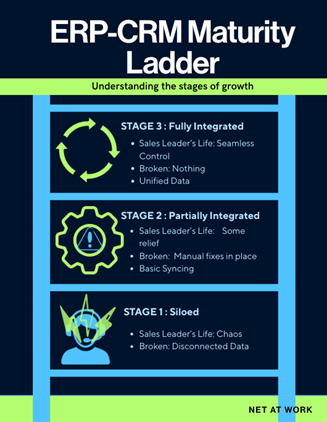
Stage 1: Siloed
Sales Leader’s Life: Chaos
Every meeting starts with “which number are we using?” Your reps are constantly Slacking ops for stock levels, delivery dates, and pricing “exceptions” because the CRM has none of the ERP context they need to close deals. You walk into forecast meetings confident and walk out explaining why 20% of your “committed” pipeline evaporated overnight. Every quote becomes a scavenger hunt. Every promised ship date is a gamble.
What’s Broken: Disconnected Data
Sales lives in CRM, ops lives in ERP, finance lives in spreadsheets. Constant rework, surprise margin hits, deals slipping because no one has the full picture. The cost? Your best reps spend more time hunting information than selling. Reps offer discounts blind to actual cost and terms because the ERP holds the real cost data.
Even worse is “The Invisible Discount,”when a rep promises a ship date the ERP can’t meet, and you have to expedite freight to save the relationship. That freight cost is an untracked discount that eats your margin alive.
What needs to change
You stop tolerating “shadow systems” and admit the problem is the gap, not the people. When your team builds workarounds in Excel, it’s because the system failed them first. Every shadow spreadsheet is a vote of no confidence in your tech stack.
Stage 2: Partially Integrated
Sales Leader’s Life: Some Relief
Some order and customer data syncs between systems, but reps still double check everything in Slack or Excel before they trust it. You’ve connected some flows, yet critical gaps remain.
What’s Broken: Manual Fixes in Place
You still reconcile reports every month, and forecast accuracy is better than Stage 1, but not board-ready. Deals still slip because reps can’t see credit holds, backorders, or partial shipments in real time.
Basic Syncing
You’ve wired some critical flows—maybe customer master sync and basic order data—but quote-to-order, credit holds, cancellations, and real-time inventory availability are still manual handoffs. McKinsey research on digital supply chain transformation shows that integrated systems can reduce forecasting errors by 30-50% through better data visibility. You’re leaving that performance on the table by staying stuck at Stage 2.
What needs to change
You start treating integration as a sales effectiveness project, not an IT project. You prioritize the flows that directly impact decision-making: real-time inventory for quotes, credit holds that affect order processing, cancellations that impact forecasts. You stop accepting “close enough” and push toward the seamless control of Stage 3.
Stage 3: Fully Integrated
Sales Leader’s Life: Seamless Control
There’s one pipeline, one number, and everyone trusts it. Won deals in the CRM automatically create and update orders in the ERP. ERP updates—cancellations, partial shipments, credit holds—flow back to the CRM in real time. Your reps see real-time pricing, inventory levels, lead times, and customer credit standing right inside the CRM when they build quotes.
What’s Broken: Nothing
The structure is there. The work shifts to coaching, strategy, and refining process. Your managers stop being data janitors and start being force multipliers. They’re not asking “is this data right?” but, “how do we win this deal?”
Unified Data
CRM shows live inventory, pricing, customer credit status, orders, and support history. No more “let me check with ops and get back to you.” No more deals dying in the “checking availability” phase. Reps quote with confidence because the data is live and the decision-making happens in the flow of work.
What changed
Forecast accuracy jumps. Margin leakage shrinks. The same McKinsey research shows that integrated systems can reduce lost sales by up to 75% by ensuring accurate, real-time information is available when decisions are being made. When the CEO asks “where are we for the quarter?” there’s one answer, and everyone trusts it.
Account reviews don’t require five browser tabs and a data analyst. Your reps walk into meetings informed, not embarrassed. More importantly, they can make smart decisions about whether to push for payment before shipping the next order,right from within the CRM. That’s not just convenience. That’s better judgment, powered by complete information.
Why Stage 3 Matters More Than Ever
If you’re nodding along but skeptical about whether you really need to climb the ladder, here’s what should concern you: Gartner research shows that 75% of B2B sales organizations will soon supplement traditional playbooks with AI-guided selling solutions.
But those AI tools are useless if the underlying data from your ERP and CRM isn’t unified. Data silos are locking you out of the future of sales technology while your competitors move ahead. You can’t leverage AI for forecasting, pricing optimization, or next-best-action recommendations when your systems don’t talk to each other.
Stage 1 and Stage 2 companies will find themselves unable to adopt the tools that are quickly becoming table stakes in mid-market B2B sales.
The Gap Between Where You Are and Where You Need to Be
Most mid-market sales leaders have been burned by integration projects that promised transformation and delivered frustration. The difference between success and failure usually comes down to three things:
First, user adoption matters more than technical elegance. The fanciest integration in the world won’t help if your team doesn’t use it. Integration must serve the people using it, not just satisfy a technical requirement. That means involving sales in the design from day one, not surprising them at go-live. CRM success is about people, not just technology.
Second, you need a platform that’s agile and adaptable. Your sales process will evolve. Your ERP will get upgraded. You can’t afford an integration that requires six months and $100K to adjust every time something changes. Modern platforms allow iterative improvements through configuration, not custom code rewrites. You need technology that empowers quick adjustments without IT bottlenecks.
Third, this has to tie to real business outcomes. Not “better data visibility” or “improved efficiency.” Actual outcomes: reduce quote-to-order errors by 30%, improve forecast accuracy by 15 points, shorten order cycle time by five days. If you can’t connect the integration to measurable P&L impact, don’t do it.
The companies climbing from Stage 1 to Stage 3 are treating integration as a business transformation project, not an IT project. They’re starting small, proving value quickly, and scaling what works. They’re building workflows around how their teams actually sell, then adapting the technology to match.
Most importantly, they’re recognizing that when frontline reps shape the solution, when managers model usage, when the C-suite asks “what does the CRM say?” instead of “send me a spreadsheet”—that’s when integration moves from a nice-to-have to a competitive advantage.
Stop Managing the Gap. Start Climbing.
If you’re staring at three versions of “the numbers” every month, the problem isn’t your team’s execution. It’s the gap between the systems they’re forced to use.
ERP-CRM integration is about giving your team the information they need to do their jobs without heroics. It’s about forecast accuracy that builds trust with the board. It’s about protecting margin in every transaction, not just the ones that get escalated.
The cost of staying at Stage 1 or Stage 2 includes lost deals, eroded margin, burned-out reps, and falling behind on the AI-driven tools that your competitors are already using.
Your CRM isn’t the problem. Your ERP isn’t the problem. The gap between them is. The good news is that it’s solvable.
The question is: which rung of the ladder are you on, and what’s stopping you from climbing to the next one?
Registration Now! – The ERP-CRM Connection : Why Integration Makes or Breaks Your Sales Process
Frequently Asked Questions
How do I know which stage of ERP-CRM integration my company is in?

If your team maintains shadow spreadsheets, asks ops for information that should be in the CRM, or debates “which number” to use in forecast meetings, you’re at Stage 1. If some data syncs but reps still double-check everything before trusting it, you’re at Stage 2. If your CRM shows real-time ERP data and everyone trusts one source of truth, you’re at Stage 3. Most mid-market companies are stuck between Stage 1 and Stage 2.
What's the biggest risk of keeping siloed systems?
Revenue leakage and competitive disadvantage. When sales teams can’t access real-time inventory, pricing, or customer credit information, they make promises the business can’t keep. McKinsey research shows that integrated systems can reduce forecasting errors by 30-50% and lost sales by up to 75%. Beyond that, Gartner predicts 75% of B2B sales organizations will use AI-guided selling by 2025,but those tools require unified data. Staying siloed means you can’t adopt the technology your competitors are already leveraging.
Can we skip from Stage 1 directly to Stage 3?
Technically yes, but it’s risky. Most successful companies move through Stage 2 deliberately by integrating a few critical flows first (quote-to-order, customer sync, inventory visibility), prove value, then expanding. Trying to do everything at once usually leads to 18+ month projects that never deliver. Start with the 2-3 flows that cause the most pain, get those working, build trust, then scale.
Do we need to replace our existing CRM or ERP to integrate them?
Many organizations evaluating the best CRM platforms for mid-market businesses assume they need a full replacement before integrating. In most cases, that’s not true. Modern integration approaches can connect disparate systems without ripping and replacing your core technology. The question is whether your CRM platform is flexible enough to adapt to your sales process while connecting to your ERP. Look for platforms designed with integration capabilities built in, not bolted on. You need a system that allows iterative improvements without requiring custom code for every change.
What's the most common reason companies get stuck with a partially integrated solution?
Poor adoption. The technology works, but the sales team doesn’t fully trust or use it because the workflow doesn’t match how they sell, or because key data points are still missing. This happens when IT or finance designs the integration without meaningful input from sales. The fix: include frontline reps and sales managers in deciding which flows to integrate next, and hard-wire the new process into compensation and coaching.
How do we measure progress as become more integrated?
Track business outcomes at each stage. At Stage 2, measure: reduction in time spent reconciling data, decrease in “where’s this information?” Slack messages, improvement in quote turnaround time. At Stage 3, measure: forecast accuracy variance, quote-to-order cycle time, margin per transaction, and lead conversion rates. Most companies see measurable ROI within 12-18 months through increased deal velocity and reduced margin leakage.
What happens if our ERP or CRM gets upgraded after we've integrated?
This is where platform architecture matters. Integrations built on custom point-to-point code often break during system upgrades, dropping you back down the ladder. Modern integration platforms use APIs and middleware that can adapt to system changes without requiring a complete rebuild. When evaluating approaches, ask explicitly how the solution handles version upgrades, including both planned and emergency patches. You want a system that maintains your progress up the ladder even when underlying systems change.