



An ERP Migration Solution for Cloud Transformation
Unlock The Promise of Digital Transformation
Legacy ERP systems were built for a different era. Today, they often create more friction than value. If your current platform struggles to keep up with change management, lacks flexibility, or holds back decision-making, it may be time for a Next Generation ERP solution .
Cloud-based ERP unlocks the agility, speed, and intelligence your business needs to thrive. It’s not just about upgrading software — it’s about transforming how your organization works, competes, and grows.
Is a Cloud Migration Calling Your Name?
From accelerating growth to cutting costs, cloud ERP systems unlock capabilities that legacy software can’t deliver. Companies typically pursue ERP migration when they’re facing challenges like:
- Business Expansion, Mergers, or Acquisitions: Your current system may not support new entities, workflows, or reporting structures.
- Inflexible or Costly Software: Older platforms often require expensive maintenance and lack modern features.
- Scalability Issues: As your business grows, legacy ERP can become a bottleneck rather than a backbone.
- Data Silos and Manual Processes: Disconnected tools lead to inefficiencies, duplicate work, and delayed insights.
- Security Risks: Outdated systems can expose your business to vulnerabilities and regulatory gaps.
- Demand for Remote Access: Today’s workforce expects secure access to real-time data — anytime, anywhere.
A Trusted Partner for Every Stage of Your Business
Next-generation technology is only as powerful as the people who put it to work. That’s why we combine a modern ERP solution with award-winning ERP migration services to help you unlock your fullest potential.
With a deep bench of experienced consultants, proven methodologies, and leading migration tools, we guide businesses through the entire ERP implementation journey — from legacy accounting systems and outdated ERPs to fully integrated, cloud-based operations. We understand where you're coming from and where you're headed, so nothing gets left behind.

Unleash Potential: Net at Work’s ERP Migration Solution
Migrating ERP software isn’t just a technical project, it’s a strategic digital transformation. Net at Work ensures a smooth, efficient, and successful migration from start to finish.
- Tailored Strategy: We align your ERP migration with your business goals, user needs, and operational priorities.
- Deep Expertise: We understand both legacy systems and modern cloud ERP, and how to bridge the gap.
- Lifecycle Support: From planning to training to ongoing optimization, we’re with you every step of the way.
Solving Your ERP Migration Challenges
ERP migrations are notorious for going over budget or off track, but they don’t have to. Net at Work helps you mitigate common ERP implementation obstacles, including:
- Scope creep
- Data loss or corruption
- Unplanned downtime
- User resistance
- Integration headaches

Our Proven ERP Migration Process
We take the guesswork out of ERP migration. Our structured process ensures a smooth transition with minimal disruption:
We evaluate your current systems, business needs, and readiness for change.
We help you choose the right ERP software based on functionality, scalability, and fit.
We prepare and securely transfer your ERP data to ensure accuracy and integrity in the new system.
We tailor the ERP solution to match your workflows, roles, and reporting requirements.
We test for functionality, performance, and data accuracy before full deployment.
We prepare your team with the tools and support they need to adopt the new system confidently.
We manage the transition to ensure a seamless cutover with little downtime.
We continue to optimize your system post-launch and provide long-term strategic guidance.
DIGITAL TRANSFORMATION JOURNEY
Explore each phase of a digital transformation journey with the on-premise ERP migration professionals at Net at Work:
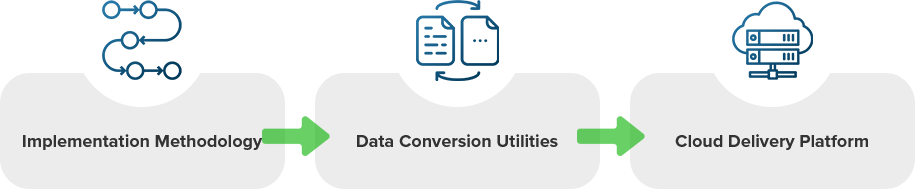
HOW WE CAN HELP YOU ON YOUR JOURNEY
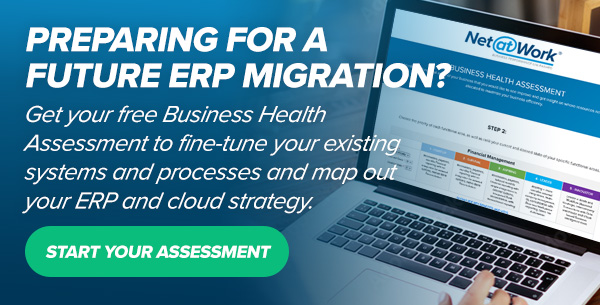
Many organizations have made large investments into their current ERP technology and may not be ready for change. Regardless of whether your company is ready to migrate to Next Generation ERP today or is seeking to prepare its ERP and cloud strategy for a future migration, Net at Work is here to support your business to reach its fullest potential – now and in the years to come.
ERP Migration FAQs
What Is ERP Migration?

ERP migration is the process of moving from one enterprise resource planning system to another — typically from a legacy, on-premise solution to a modern, cloud-based platform. It involves transferring ERP data, reconfiguring workflows, and ensuring continuity across business functions.
How Do I Transfer Data From One ERP System to Another?
The transfer begins with data mapping your existing structure to the new system, followed by cleansing, formatting, and securely migrating it using specialized tools and processes to preserve accuracy and integrity.
Is My Data Secure During Migration?
Yes, with the right partner and protocols, your assets remain secure throughout the data migration process. Net at Work uses proven methods and strict validation procedures to protect sensitive information at every stage.
How Long Does ERP Migration Take?
The data migration process varies based on your system complexity, data volume, and organizational readiness, but most projects range from a few weeks to several months. Net at Work works closely with you to set realistic timelines and minimize disruption.
What Happens to My Legacy Data?
Legacy data is either migrated to the new system, archived for compliance, or selectively retained based on business needs. Net at Work helps you determine what to migrate, what to keep, and how to ensure ongoing access when needed.
Featured Cloud Migration
Resources & News
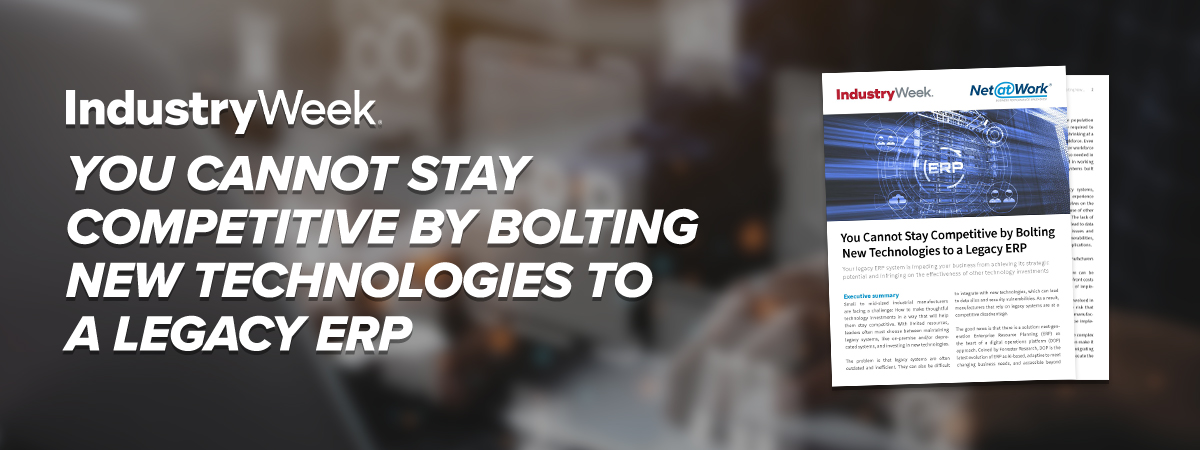

-Doug Mow, CMO at Net at Work Know When to Go The panelists connected on a common goal, however. Both stressed the importance of properly serving the customer. Jones explained that ERP or DOP solutions should stand to meet the needs of customers through operational effectiveness, speed of service and customer experience. He also cautioned against the “temporary fix where really you need to change the underlying solution.” St. Armand echoed this sentiment. “If we were going to make a change, then it would need to be something that did more, that did it better. Not something that would take away from the customer service that we already provide,” she said. If you find that your current system isn’t helping you fulfill your customer promise, that’s when options like a Business Health Assessment or other analysis may be needed to help you map out your technology strategy to overcome existing shortcomings. “At Net at Work,” explained Doug Mow, Chief Marketing Officer with the company, “We do not believe that there is any one right answer. There is only the best answer for your organization and what you are going through at this moment…we just urge you to make that decision well informed and commit to it.” To learn how your organization can benefit from a strategic partnership with one of the leading technology consulting firms in the United States, contact Net at Work today.


Five Hallmarks of Next-Gen ERP Applications
2. Enhanced Workflows: Smart workflows and process automation that reduce or eliminate manual touchpoints and keep tasks on target.
3. Flexible Commerce: Tools to help your business transact the way your customers and business partners want, including eCommerce, EDI, subscription options, and customer/vendor portals.
4. Platform Ecosystem & Globalization: Technology to help your organization complete in a global marketplace, including flexible deployment options and multi-language support.
5. Global/Scalable Financial Functionality: Capabilities that support growth at a global scale including multi-company, multi-currency, and multi-book plus advanced reporting and analysis functions. Why Next Gen now? You may be thinking, my ERP is working just fine, why should I consider updating to a Next Gen ERP solution? There are many good reasons to make the switch, but perhaps the most compelling reason is that it’s likely your competitors already have. Gartner predicts that by 2023, 65% of companies will use ERP applications that can be categorized as fourth-era or Next Gen. It’s time to begin planning your organization’s move, or you risk being outperformed by more nimble competitors. Legacy ERP systems don’t meet many of the needs of modern enterprises operating in a rapid-evolving technology ecosystem. They’re not adaptive or intelligent enough. They don’t support streamlined remote access, require too many manual touchpoints and workarounds, nor do they provide the deep insight necessary for strategic decision making. Conversely, Next Gen ERP applications are built on modern technology that is easy to work with and simple to maintain. They offer capabilities that allow an organization to scale operations efficiently, without adding more administrative personnel. They harness vast amounts of vital business data and allow you to query and present that data for faster and better decision making. In addition, Next Gen ERP applications support and advance your relationships with customers and business partners. And they support global operations and continued growth. If your organization is considering a generational shift in its ERP strategy, we would welcome the opportunity to assist you in selecting and unleashing the best solution for your needs. In the meantime, join us for this continuing series detailing the power of Next Gen Business Management Software.
Contact a Legacy ERP Migration Specialist Now.
Our experts are ready to answer any questions you may have. Use the contact form or contact us directly below: